

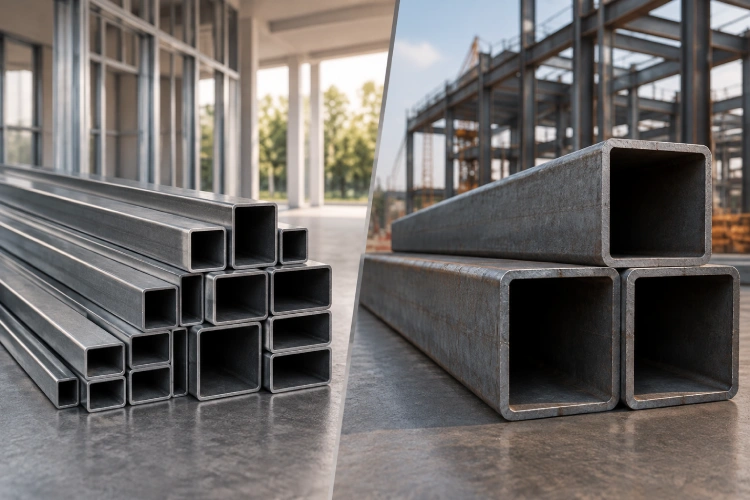
When examining the difference between lightweight and heavy profiles, several key factors should be considered, including sheet thickness, weight per section, manufacturing method, load-bearing capacity, and intended application. Therefore, it cannot be said that a heavy profile is always the better choice or that a lightweight profile is always more economical; the right selection depends on the project requirements.
If you are planning to purchase profiles for construction, industrial, or civil engineering projects, understanding the difference between lightweight and heavy profiles can help you select a product that matches your actual requirements without incurring unnecessary costs. Keyhan Rolling provides specialized consultation to help customers select the appropriate profile.
What Are Lightweight and Heavy Profiles and How Do They Differ?
Profiles are hollow steel sections that are classified into different categories based on sheet thickness, weight, and production standards. Two widely used categories are lightweight and heavy profiles, each designed for specific applications.
Lightweight profiles are generally manufactured from thinner sheets and have a lower weight. In contrast, heavy profiles are made from thicker sheets and provide greater mechanical strength.
In general, the main differences between these two types of profiles include the following:
| Feature | Lightweight Profile | Heavy Profile |
| Sheet Thickness | Lower | Higher |
| Section Weight | Lower | Higher |
| Compressive Strength | Suitable for lightweight applications | Suitable for heavy loads |
| Price | Generally more economical | Higher due to greater steel consumption |
| Main Applications | Decoration, furniture, lightweight structures | Construction, industrial projects, heavy-duty structures |
Difference Between Lightweight and Heavy Profiles in Terms of Sheet Thickness
One of the most important criteria for distinguishing between lightweight and heavy profiles is the thickness of the sheet used in their production. Greater thickness means higher steel consumption and, consequently, increased product weight and strength.
Lightweight profiles are generally manufactured with thinner sheets and are used for applications where the section is not subjected to high loads. In contrast, heavy profiles, due to their greater thickness, can withstand higher forces.
For example, in projects where the profile forms part of a load-bearing structure, selecting the appropriate thickness is critical, as reducing thickness without engineering assessment can compromise structural safety.
When purchasing, considering the profile’s apparent dimensions alone is not sufficient. Specifications such as actual thickness, weight per section, and production standard should also be checked.
Comparing the Weight of Lightweight and Heavy Profiles; Which Is More Economical?
Weight is another key criterion when comparing lightweight and heavy profiles. As sheet thickness increases, the weight of the profile section also increases.
Many buyers assume that lightweight profiles are always the more economical option; however, this is not always the case. If the selected product does not provide sufficient strength for the project requirements, the costs of repair, replacement, or structural reinforcement can be several times greater than the initial savings.
For a better comparison, the following factors should be considered:
- Required Weight to Support the Project Load
- Transportation Costs
- Steel Consumption
- Structural Service Life
- Installation & Execution Conditions
In large-scale projects, product selection should be based on technical calculations, not just the initial price.
What Are Lightweight Profiles Mainly Used For?
Due to their lower weight and good formability, lightweight profiles are used in a wide range of lightweight and non-structural applications.
The main applications of lightweight profiles include:
- Lightweight Metal Equipment Manufacturing
- Metal Furniture Production
- Interior Frames
- Decorative Structures
- Certain Industrial Components
- Manufacturing Products Requiring Easy Cutting and Forming
In these applications, reducing the product weight can help lower transportation costs and accelerate installation.
For projects requiring a variety of standard sections, reviewing the specifications of different steel profilescan help ensure a more precise selection.
What Are Heavy Profiles Used For?
Heavy profiles are generally used where strength, durability, and load-bearing capacity are more important than reducing weight.
Some of the main applications include:
- Steel Structures
- Large-Scale Civil Engineering Projects
- Industrial Structures
- Machinery Manufacturing
- Factory Equipment
- Structures Subject to High Pressure and Heavy Loads
In projects such as industrial sheds, factories, or large structures, using an unsuitable profile can increase construction risks. Therefore, choosing a supplier that can provide accurate technical specifications is highly important.
Difference Between Lightweight and Heavy Profiles in Construction Applications
In construction, the choice between lightweight and heavy profiles should be based on the role of the component within the structure. A profile suitable for interior components is not necessarily an appropriate choice for the main structural elements.
In general:
- For decorative and non-load-bearing components, lightweight profiles can be a suitable option.
- For parts exposed to high pressure, impact, or heavy loads, heavy profiles are a more reliable choice.
- In large-scale projects, technical specifications should be reviewed before purchasing.
For this reason, many contractors and project managers review their requirements with the supplier’s experts before placing an order.
How to Choose the Right Profile for Your Project?
Choosing the right profile cannot be based solely on its apparent dimensions. Various factors should be evaluated to ensure that the final product is technically and economically suitable.
Before purchasing, it is recommended to consider the following:
- Final Application of the Profile
- Load Applied to the Structure
- Project Environmental Conditions
- Required Standard
- Order Volume
- Expected Delivery Time
Purchasing from a supplier that provides technical consultation in addition to selling products can also help reduce selection errors.
Why Is Choosing a Reliable Profile Supplier Important?
In the steel market, differences in product quality are not always visible from appearance alone. The quality of the raw sheet, manufacturing precision, thickness control, and compliance with the order specifications all affect the final outcome of a project.
A professional supplier should be able to provide accurate product information and support customers throughout the process, from product selection to delivery.
Keyhan Rolling focuses on supplying steel products and aims to meet the needs of construction, industrial, and civil engineering projects by offering standard products and specialized consultation. The goal is not simply to sell a product, but to help customers choose a solution that delivers the best technical and economic results for their project.
If you are unsure about choosing between a lightweight or heavy profile, selecting the appropriate thickness, or determining the required quantity for your project, you can contact Keyhan Rolling’s expertsfor more precise guidance before purchasing.
Conclusion: Should You Choose a Lightweight or Heavy Profile?
Ultimately, there is no universal answer as to whether lightweight or heavy profiles are always better. The right choice depends on the type of project, load requirements, installation conditions, and budget.
The difference between lightweight and heavy profiles is mainly defined by three factors: thickness, weight, and application. Lightweight profiles are suitable for applications where reducing weight is important, while heavy profiles are preferred when strength and load-bearing capacity are the primary priorities.
For professional projects, product selection should be based on technical information and specialized consultation. Making the right choice at the beginning can help reduce future project costs and improve the quality of the final execution.
Lightweight vs. Heavy Steel Profiles: Comparing Thickness, Weight, and Applications